 Hello. This is InfoTherapy, prescribing healthy information.
I am a manual therapist with 10 years of experience correcting the collapsed spines and pelvises of countless patients in the field. When I meet patients—office workers, developers, and students who sit at desks all day wrestling with monitors—in my clinic, there is a repertoire I hear very frequently.
“Doctor, my back hurt so much that I bit the bullet and switched to a high-end chair costing over 2 million won. It felt comfortable for the first few days, but by the afternoon, my back feels like it’s going to break and my neck is stiff just the same. Are expensive chairs just a marketing gimmick?”
When back pain strikes, modern people first suspect the 'chair' they are sitting on and open their wallets for more expensive, ergonomic equipment. However, as a manual therapist who deals with the mechanics of patients' bones and joints every day, let me tell you a brutally honest, objective fact. The reason your back hurts is not because the chair is cheap. It is because the foundation you lay upon—that is, the 'position of your pelvis'—has completely collapsed.
Today, I will uncover the hidden ergonomic truth behind the principles by which expensive office chairs costing millions of won provide back comfort, and I will reveal in great detail a miraculous pelvic correction setting method that transforms the cheap office chair I use in my clinic into a Herman Miller-class high-end chair for a mere 0 won, using only 'two towels' lying around the house.
The Real Secret of Expensive High-End Chairs: Seat Pan Tilt and Weight-Centered Pelvic Correction
Chairs costing millions of won are not expensive simply because they have good cushioning or soft backrests. Among the numerous features provided by high-end chairs, the most critical and essential role for spinal health lies in the ability to finely adjust the angle of the seat pan you are sitting on back and forth.
When you plop down in a chair, if you place your hands under your buttocks, you can feel hard bones protruding on both sides. In medical terms, this is called the 'ischial tuberosity.' The angle at which these ischial tuberosities touch the seat of the chair determines the lifespan of your spine.
Most ordinary chairs have flat seat cushions or are actually sunken inward. When you sit on such a chair, your pelvis naturally tilts backward (posterior tilt); if this foundation—the pelvis—collapses, the C-shaped curve of the lumbar spine—the pillar built upon it—straightens out or bends backward. As the lower back collapses, a compensatory mechanism occurs where the back hunches and the head juts forward, resulting in a "turtle neck" posture. In this state, no matter how hard you try to tense your lower back and keep your head upright, your muscles will scream in pain before you can last more than five minutes.
On the other hand, expensive ergonomic chairs allow for settings that slightly elevate the back of the cushion (towards the buttocks) and subtly tilt the front (towards the thighs) downward. What happens when the cushion tilts slightly from back to front? As the back of the pelvis rises, the entire pelvis naturally tilts forward as if rolling slightly (anterior tilt). When the pelvis is properly aligned in this way and your center of gravity shifts precisely to the front of the pelvis (slightly in front of the ischial tuberosities), something amazing happens. Without having to strain your lower back or upper back, the spine springs on its own to effortlessly find the most stable "neutral C-shape," and the head rests most healthily and lightly on the cervical spine. This is the principle of pelvic correction.
Ultimately, the key to expensive chairs lay not in pushing the lower back from behind, but in the 'angle of the cushion that tilts the pelvis slightly forward to balance the center of gravity.'.
0-Won Home Care by a Therapist with 10 Years of Experience
If you understand the principle of replicating the function of a 2-million-won chair with just two towels, there is no need to spend a fortune. Although I sit in a very ordinary, inexpensive office chair when seeing patients in my clinic, I protect my spine by perfectly replacing the seat cushion's tilt function using a common household towel. I will share detailed tips on a manual therapist's zero-cost pelvic correction setup that anyone can follow right now.
Step 1: Gathering Supplies. Prepare 2 to 4 ordinary towels used at home. (It is recommended to prepare plenty, as you may need to adjust the thickness depending on your body type or the sagging of the chair.)
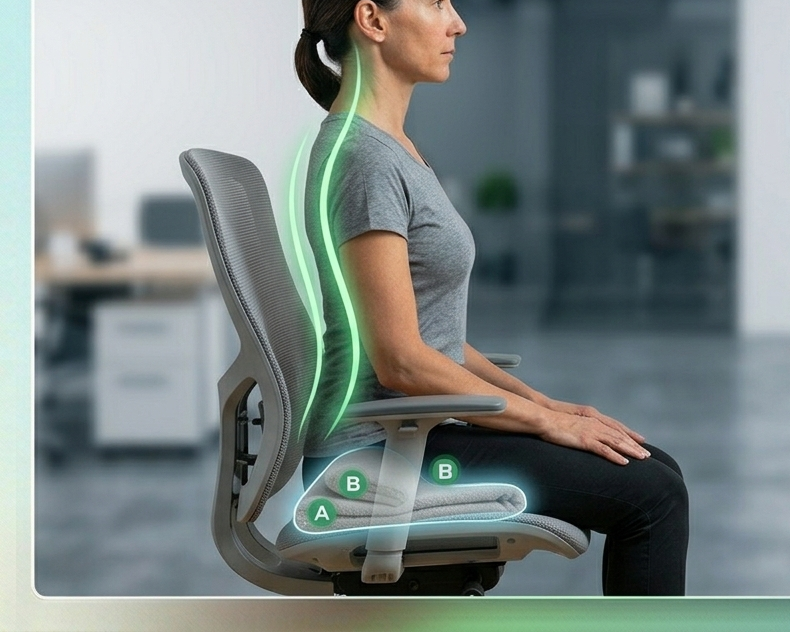
Step 2: Making a base cushion towel (A) Lay out a towel and fold it in half horizontally. This creates a square base towel (A) roughly the size of a chair cushion. Place this on the bottom of the chair.
Step 3: Making the Magic Ramp Towel (B) (Key) Fold the remaining towel horizontally into three equal parts (or four if you want it a little thicker) to create a long, thick rectangular towel (B).
Step 4: Assembling the High-End Chair Setup. Gently lift the back side (the backrest side where the buttocks touch) of the base cushion towel (A) placed on the chair, and insert the thickly folded slanted towel (B) horizontally between them. In other words, by placing a small towel between the towels folded in half like a sandwich, you create a 'wedge' shape so that only the back cushion area of the chair bulges out.
Step 5: Sit and Check Center of Weight. Now, try sitting on it. Since the back of your buttocks is slightly elevated by the towel, the moment you sit down, you will naturally feel your pelvis tilting forward pleasantly, as if sliding down a slide. Even without forcing your back straight, you can feel your entire body as the center of weight shifts forward thanks to the elevated back of your pelvis, automatically creating the C-curve of your lumbar spine. If the angle is insufficient, increase the number of towels (B) inside to 2 or 3 to set the perfect incline that fits your body type.
The spine breathes only when the pelvis is healthy. Of course, this towel setting method has its downsides. As you repeatedly sit down and stand up, the towel gets disheveled, requiring the hassle of manually adjusting its shape. However, if enduring just a little inconvenience allows you to perfectly replicate the core biomechanical functions of a multi-million dollar high-end chair, there is likely no pelvic correction method in the world with such overwhelming cost-effectiveness.
Although I treat countless disc patients on-site, even if pain is reduced through injections or manual therapy, it is ultimately like pouring water into a leaky bucket if the posture of sitting for eight hours a day collapses. The real secret to maintaining spinal health for a long time is not simply straightening the back itself. Correctly setting the angle of the 'pelvis,' the cornerstone supporting the spine, is the beginning and the end of all treatment.
Take two towels out of your closet today and place them on your office chair or your desk chair at home. The moment your pelvis is properly aligned and your center of gravity shifts forward, you will experience the miracle of pelvic correction, where your back and neck, which you have been straining to hold, will feel miraculously comfortable. Until the day your spine is freed from the pressure of gravity and can breathe comfortably, Infotherapy will protect your health with realistic and solid facts.
References and cross-verified data
Spine Journal (International Spine Journal): Link to the paper on the biomechanical analysis of the effects of weight-bearing position of the ischial tuberosities and anterior pelvic tilt on spinal neutral alignment and reduction of intradiscal pressure in lumbo-pelvic rhythm: https://www.thespinejournalonline.com/
American Physical Therapy Association (APTA): Link to Guidelines for Conservative Prevention of Low Back Pain Using Wedge Cushions and Ergonomic Chair Design Principles for Sedentary Work Environments: https://www.apta.org/
Journal of Physical Therapy Science: Research on the direct correlation between changes in seat pan inclination and electromyographic activity of trunk muscles (erector spinae, etc.) and forward head displacement (turtle neck) during sitting Link: https://www.jstage.jst.go.jp/browse/jpts
See other posts
Thumb throbbing? De Quervain's tenosynovitis: 1-second diagnosis and home care to avoid surgery
3 Simple Stretches to Fix Forward Head Posture (Tech Neck) and Expert Tips