Hello. This is InfoTherapy, prescribing healthy information.
Recently, a patient in their 40s who had been suffering from severe back pain for over a year visited the treatment room. They had gone from hospital to hospital and even had two MRI scans, but the doctors' answers were all the same: “The disc has fully healed. There are no major structural issues.”
However, the patient complained that their lower back hurts so severely from the moment they open their eyes in the morning until they fall asleep at night that it is on the verge of depression. They say there are no problems with their bones or discs, so why on earth won't the pain go away?
Patients are not faking their illness. They are indeed in pain. However, the cause of that pain lies not in the lumbar structures, but in a 'system failure.' Today, from the perspective of a manual therapist with 10 years of experience, I will delve deeply into the paradigm of treating chronic lower back pain—where pain is felt more acutely than the actual injury—practical methods to break this cycle of pain in daily life, and pelvic correction, which is the root of the spine.
The Trap of 'Neuroplasticity' in Chronic Back Pain: Where the Brain Has Learned Pain
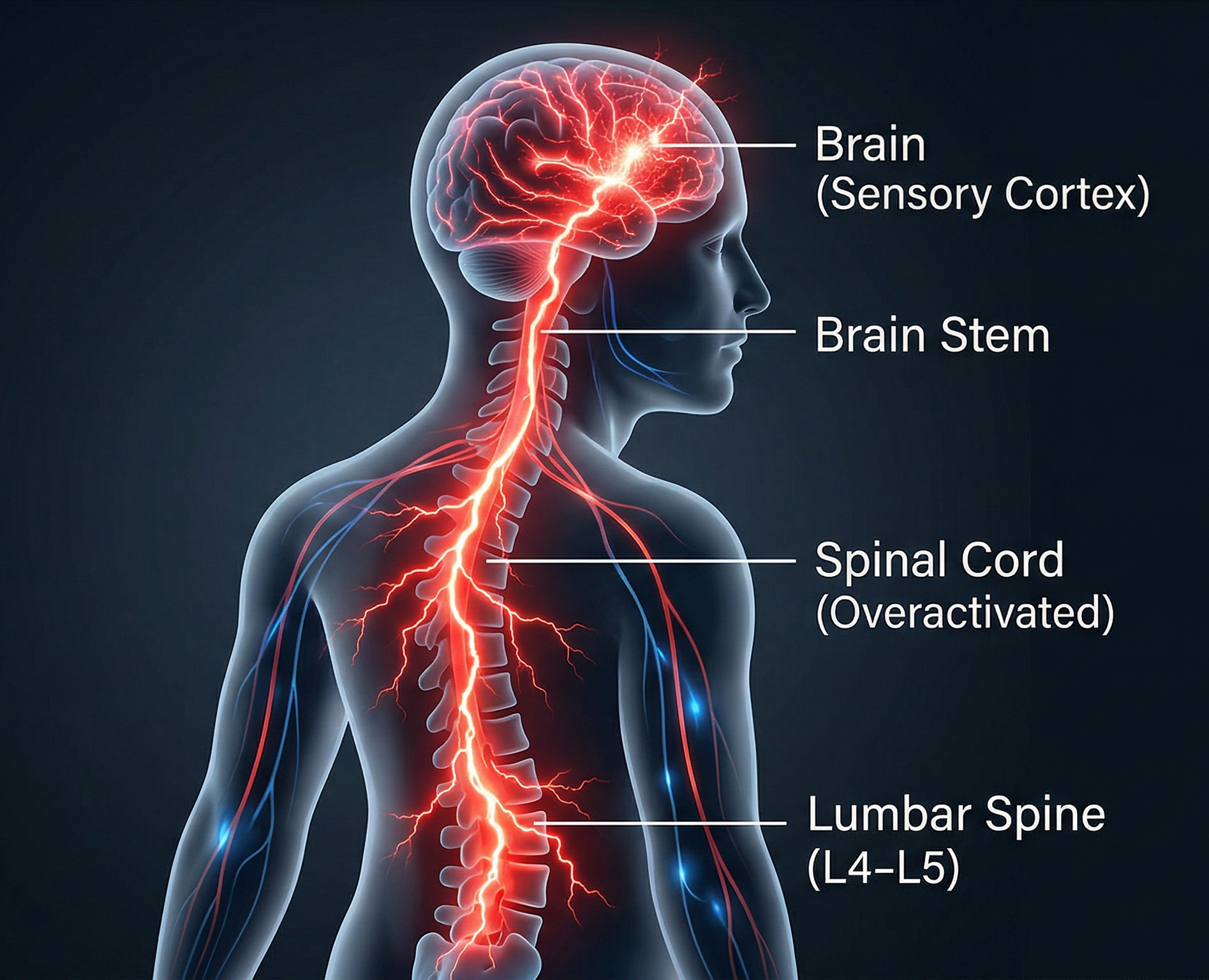
Acute lower back pain caused simply by overexertion for a few days and 'chronic pain' lasting for more than three months require completely different approaches. Chronic lower back pain is not merely damage to bones or muscles, but a condition in which the very structure of our nervous system has changed.
A broken alarm that sounds a siren even when the wind blows
Our body's nervous system has the property of developing and changing in the direction of frequent use. This is technically called **'neuroplasticity'. It is the same principle as how repeated studying creates pathways in the brain, leading to better memorization.
The problem is that this plasticity applies to pain as well. If actual back injury occurs and the body is continuously exposed to pain signals for three, six, or more months, our brain and nervous system become structured to be extremely sensitive to pain. This is called central nervous system sensitization.
Even though actual damage to the lumbar discs or ligaments heals and recovers within one to two months, the brain has already learned that "the lower back is a dangerous and painful place." Consequently, the nervous system reacts exaggeratedly to stimuli that should only cause a pain level of 10 (such as slightly bending over or walking), spewing out extreme pain of 100. It has become a "broken burglar alarm" that rings loudly even when a breeze merely brushes past, without any actual break-in.
'Daily routines' to break the chain of endless pain‘
In a state where the nervous system is hypersensitive like this, receiving injections beneficial for the back or undergoing physical therapy is like pouring water into a leaky bucket. Before beginning full-scale treatment for chronic lower back pain and joint issues, the very first thing you must do is physically break the 'pain cycle' to prevent the broken alarm from going off.
A new stimulus that distracts nerves from pain
If you are consumed by the thought, “Ah, my back hurts. What if it hurts again?” all day long, your brain strengthens its pain circuits. To break this cycle, you need new stimuli that do not strain your body.
Engaging in light hobbies, walking in warm water, and performing gentle stretching and breathing exercises within a pain-free range are excellent ways to send a signal to the brain that it is 'safe.' By allowing the brain to focus on other pleasant sensations or comfortable movements instead of pain, it gradually switches off the exaggerated pain switch.
Meticulous lifestyle habits that completely eliminate back irritation
No matter how good the manual therapy you receive in the treatment room, if you return home and repeat behaviors that damage your back, your nervous system will sound the alarm again. Improving lifestyle habits to manage back pain is not an option, but a necessity. You must thoroughly reduce mechanical stimulation to your back to maximize "pain-free time.".
-
When getting out of bed in the morning: Morning is the most vulnerable time because the discs have swollen from retaining moisture overnight. Do not jump up abruptly; instead, lie on your side and slowly get up by placing your arms on the floor and pushing off (the log rolling technique). This is the first step in preventing morning back pain.
-
When washing your hair: Slouching over the sink to wash your hair is like dropping a nuclear bomb on your herniated disc. You must use a showerhead and wash your hair while standing with your back straight.
-
When vacuuming or washing dishes: Do not lean on one leg or slouch. Place a step stool 10 to 15 cm high under the sink and alternate placing one foot on it, or assume a lunge position by stepping one foot forward like a fencer. This stabilizes the pelvis and reduces the load on the lower back by more than half.
The Master Key to Back Pain Treatment, 'Pelvic Position'‘
If you have soothed the brain's illusions and reduced the stimulation of daily life, you must now address the structural root cause. One thing I am convinced of after treating countless patients over the past 10 years is that **"just properly aligning the pelvis completes half of the treatment for chronic lower back pain."**.
The pelvis, the cornerstone that determines the shape of the spine
When constructing a building, if the ground is not flat, the pillars stacked upon it are bound to naturally bend. In our bodies, the pelvis is the floor (foundation), and the spine is the pillar.
When evaluating patients with back pain in the treatment room, nine out of ten times, their pelvic position is misaligned. Those who frequently wear high heels or have large bellies develop anterior pelvic tilt (duck butt posture), where the pelvis tilts forward, causing the joints in the lower back to bend excessively and be compressed. Conversely, those who sit hunched over while working develop posterior pelvic tilt (straight back), where the pelvis rolls backward, putting the discs at risk of slipping backward.
How to sit upright without straining
If you force yourself to keep your back straight while your pelvis is misaligned, your spinal erector muscles cannot rest and must remain excessively tense all day long. Eventually, you fall into a vicious cycle where your muscles become fatigued, stiff, and painful.
The key to treatment is finding the 'Neutral Pelvis' position, where the spine can rest most comfortably whether standing or sitting. When sitting, push your hips deep into the back of the chair and firmly support the floor with your pelvis (ischial tuberosities), rather than your lower back. When the pelvis is aligned at the correct angle, the lumbar spine can maintain a natural and comfortable C-shaped curve (lumbar lordosis) without having to exert excessive force. This is the most scientific principle for eliminating pain by preventing the waste of unnecessary muscle energy.
Summary and Infotherapy Prescription
-
Chronic back pain that does not heal is more likely to be a problem of 'neuroplasticity,' where the nervous system becomes hypersensitive to pain, rather than actual structural damage to the lower back.
-
Before beginning full-scale treatment, you must stop the 'painful flow' of the nervous system by thoroughly eliminating lifestyle habits that irritate the lower back, such as waking up in the morning, washing, and doing housework.
-
The 'position of the pelvis,' which is the root of the spine, determines the shape of the spine. Simply establishing a neutral pelvis can prevent muscle overload and treat half of the pain.
Treating chronic lower back pain is not a condition that magically heals with just a few days of medication or injections. It is a long journey of erasing pain memories incorrectly learned by the brain, overhauling daily movements, and recognizing the proper pelvic position for your body type. However, if you navigate this process correctly, you can break free from exaggerated fears and regain a healthy daily life. I encourage you to start by changing your habit of getting out of bed today.
This has been Infotherapy, prescribing healthy information. Thank you.
See other posts
Chondromalacia: Why It Occurs Even Without Exercise (5 Minutes of Daily Running for Beginners)
Solve Your Parents' Knee Pain with Just One Thermos?
References (References with Links)
-
Nijs, J., et al. (2012). “Thinking beyond muscles and joints: therapists’ and patients’ attitudes and beliefs regarding chronic musculoskeletal pain are key to applying effective treatment.” Manual Therapy.
-
Research Topic: Understanding Neuroplasticity and Central Nervous System Sensitization in Chronic Musculoskeletal Pain, and the Importance of Brain Learning Block (Pain Cycle) through Changes in Patient Pain Perception.
-
-
O'Sullivan, P. (2005). “Diagnosis and classification of chronic low back pain disorders: maladaptive movement and motor control impairments as underlying mechanism.” Manual Therapy.
-
Research Topic: A study on the mechanical mechanisms by which improper motor control and maladaptive pelvic/lumbar postures perpetuate pain in patients with chronic low back pain.
-
-
Laird, R. A., et al. (2014). “Comparing lumbo-pelvic kinematics in people with and without back pain: a systematic review and meta-analysis.” BMC Musculoskeletal Disorders.
-
Research Topic: Kinematic comparison of the pelvis according to the presence or absence of low back pain. Differences in pelvic tilt (anterior/posterior tilt) and spinal load mechanics during daily movements among patients with low back pain.
-