Hello. This is InfoTherapy, prescribing healthy information.
Recently, a patient in their late 30s, an office worker, visited my treatment room with a pale face. “Doctor, for the past few days, my arm has been tingling so intensely that it feels like it’s going to explode, to the point where I wake up at night. The sensation in my fingertips also seems dulled… I looked it up online and it sounded exactly like the symptoms of a herniated cervical disc, so I went to a neurosurgeon and even paid a lot of money to get a neck MRI, but they said my discs were perfectly clear and normal. I don’t know the cause, and I feel so frustrated.”
Upon examining the patient's posture, I noticed their shoulders were severely rounded inward, and their neck was jutting forward as if it were being sucked into the monitor. When I asked about their occupation, they stated that as a developer, they spend over 10 hours a day coding while staring at a heavy 16-inch laptop monitor, and that their only pleasure after work is playing games on a heavy tablet.
This patient's diagnosis was not a herniated cervical disc. It was Thoracic Outlet Syndrome (TOS), a condition caused by a hunched posture compressing the nerves and blood vessels beneath the clavicle. Today, from the perspective of a manual therapist with 10 years of experience, I will delve deeply into the anatomical principles of TOS symptoms—which torment us by perfectly disguising themselves as a herniated cervical disc—and a practical treatment routine designed to clear up these clogged nerves.
The triangle below the clavicle, the tragedy of 'thoracic outlet syndrome'
To properly understand the symptoms of thoracic outlet syndrome, you must first understand the unique anatomical structure of our body called the 'thoracic outlet.'.
The highway of nerves running from the neck to the arm
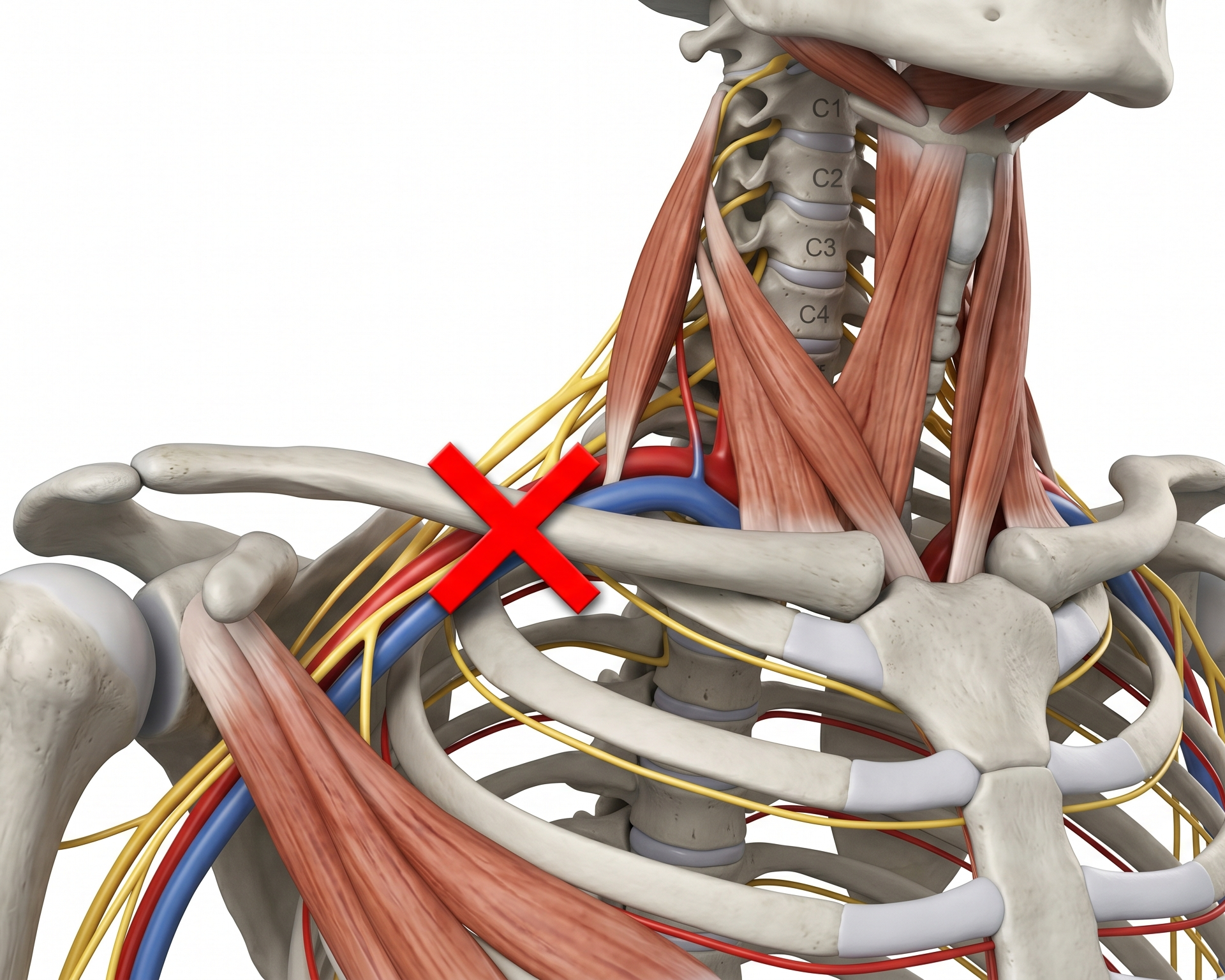
The massive bundle of nerves (brachial plexus) emerging from our neck vertebrae and the blood vessels pumped from the heart must pass through a narrow tunnel to descend to the arms. This tunnel passes through the gap between the scalene muscles, which are located at the front of the neck, through the narrow space between the clavicle and the first rib, and passes beneath the pectoralis minor muscle, which is located at the front of the chest.
This entire complex and narrow passage is called the 'thoracic outlet.' In a normal body shape, there is sufficient space in this tunnel for nerves and blood vessels to communicate smoothly. However, if the body shape collapses, this tunnel turns into a terrifying trap that crushes the nerves.
The process of 10 hours of desk work crushing the nerves
Imagine the posture of looking down at a monitor all day while using a heavy, high-performance laptop, like the previous patient, or the posture of slouching on a sofa after work while staring at a smartphone or tablet.
If rounded shoulders worsen, the pectoralis minor muscle in the front of the chest shortens and stiffens. At the same time, a "turtle neck" posture, where the head juts forward, causes the scalene muscles in the front of the neck to tighten like rocks. Eventually, the hardened scalene and pectoralis minor muscles constrict the nerve bundles and blood vessels running from the neck to the arms, as if tied with a rope. This is the core cause of unexplained arm numbness, and since there are no issues with the bones or discs, it is the reason why neck MRIs come back normal.
Is the numbness in my arm a herniated disc or thoracic outlet syndrome?
Before proceeding with manual therapy in the treatment room, the part of the physical examination I devote the most effort to is differential diagnosis. There are distinct differences that patients can check for themselves at home.
Unique characteristics of thoracic outlet syndrome symptoms
In the case of a cervical disc herniation, the area of numbness tends to be distinct because specific nerve roots are compressed (e.g., numbness only in the thumb and index finger). On the other hand, if an entire nerve bundle or blood vessel is compressed at the thoracic outlet, the entire arm feels heavy and stiff, or a strong tingling sensation occurs, particularly along the fourth and fifth fingers (towards the little finger).
In addition, because it is accompanied by vascular compression, symptoms include a sensation of poor blood circulation in the arms, Raynaud's syndrome (cold hands and feet), and in severe cases, swelling of the hands and pale skin. You should strongly suspect this condition, especially if it is accompanied by sleep disorders where you wake up at night due to severe numbness in your arms, which improves slightly when you shake or massage them.
A simple 'Roos Test' to do at home‘
Right now, spread your arms to the sides, bend your elbows to a 90-degree angle, and raise your hands to ear level (as if in a surrender position). In that position, try repeating the motion of clenching and unclenching your hands for 3 minutes.
If you experience severe arm numbness or sensory abnormalities before completing three minutes, or if your arm feels like it is about to fall off, it is highly likely to be a symptom of thoracic outlet syndrome. This is because raising your arm causes the space between the clavicle and the first rib to narrow, strongly compressing the nerve.
Everyday prescriptions to let compressed nerves breathe
Now that the cause of the condition has been identified, it is time for treatment. Since it is not a herniated disc, neck traction treatment is not very effective. The key is to widen the narrowed tunnel and loosen tight muscles to secure space for the nerves to breathe. While aligning the bones through manual therapy is important, daily self-care at home accounts for 80% of a complete recovery.
1. Open the Tight Chest: Pectoralis Minor Massage and Relaxation
You must release the pectoralis minor, the biggest culprit causing rounded shoulders. The pectoralis minor is hidden inside the pectoralis major (large chest muscle) so it is not easily felt from the outside.
-
Try pressing deeply on the outer point below the clavicle (the indentation where it meets the shoulder blade) with two or three fingers of your opposite hand. You will feel a band-like muscle that is painful enough to make you cry out in pain.
-
While gently pressing this area, slowly rotate your arm, or place a massage ball between the wall and your chest and rub it using your body weight.
-
Even if you consistently perform this pectoralis minor massage for just 5 minutes every day, the anterior tunnel that was compressing the nerve widens, and the numbness dramatically decreases.
2. Cut the ropes at the front of the neck: Scalene muscle stretch
You need to stretch the scalene muscles that are constricting the brachial plexus like a noose at the front of the neck.
-
While sitting, gently press and stabilize one clavicle with your opposite hand. (This prevents the muscle from rising.)
-
Slowly tilt your head diagonally backward to the opposite side. (If you pressed the right collarbone, tilt your head backward to the left.).
-
Hold for 15 seconds while feeling the diagonal muscles in the front of the neck stretch taut. However, if arm numbness worsens while performing this quadratus muscle stretch, it means the nerve is being excessively pulled, so you must stop immediately and adjust the angle.
3. Rounded Shoulder Correction and Fundamental Thoracic Spine Straightening
No matter how much you loosen the muscles in the front, without the supporting muscles in the back, your shoulders will roll back due to gravity. The completion of rounded shoulder correction lies in strengthening the stretched back muscles (rhomboids and lower trapezius). To straighten your back after hunching over a monitor all day, make it a routine to lie down with a foam roller placed horizontally under your shoulder blades (middle of your back) and open your chest wide in an overhead position. When your back stands upright, the space at the thoracic outlet naturally opens up.
Summary and Infotherapy Prescription
-
If accompanied by arm numbness, reduced sensation, and cold hands and feet similar to a herniated disc, but the MRI is normal, it is highly likely to be symptoms of thoracic outlet syndrome.
-
The cause of arm numbness is forward head posture and rounded shoulders resulting from prolonged use of PCs and smart devices, which contract the muscles in the front of the neck (scalene muscles) and the front of the chest (pectoralis minor), compressing the passageways of nerves and blood vessels.
-
To revitalize the nerves, you must not simply massage the neck; instead, you must open up the anterior space through pectoralis minor massage and quadratus muscle stretching, and fundamentally correct your body posture by addressing rounded shoulders.
Just because your arm is numb does not necessarily mean you need to have your spinal nerves surgically altered or undergo expensive procedures. Our bodies are interconnected, and it is much more common for the location where pain manifests to be different from where the actual underlying cause lies. I hope you perform a self-diagnosis using the loose test I shared today, and regain a refreshing and light feeling in your arm through a routine that opens up your chest.
This has been Infotherapy, prescribing healthy information. Thank you.
See other posts
Chondromalacia: Why It Occurs Even Without Exercise (5 Minutes of Daily Running for Beginners)
Solve Your Parents' Knee Pain with Just One Thermos?
References (References with Links)
-
Illig, K.A., et al. (2016). “Reporting standards of the Society for Vascular Surgery for thoracic outlet syndrome.” Journal of Vascular Surgery.
-
Research Topic: Clear diagnostic criteria for thoracic outlet syndrome presented by the Korean Society of Vascular Surgery, anatomical compression sites (scalene muscles, pectoralis minor), and clinical symptom reporting standards.
-
-
Hooper, T. L., et al. (2010). “Thoracic outlet syndrome: a controversial clinical condition. Part 1: anatomy, and clinical examination/diagnosis.” Journal of Manual & Manipulative Therapy.
-
Research Topic: Clinical considerations regarding the anatomical structure of thoracic outlet syndrome, evaluation models for conservative physical therapy/manual therapy, and differential diagnosis from cervical disc herniation (loos test, etc.).
-
-
Levine, N. A., & Rigby, B. R. (2018). “Thoracic Outlet Syndrome: Biomechanical and Exercise Considerations.” Healthcare (Basel).
-
Research Topic: Biomechanical Effects of Rounded Shoulder and Forward Head Posture on Thoracic Outlet Syndrome and the Importance of Scalene and Pectoral Muscle Stretching and Scapular Stabilization Exercises for Conservative Rehabilitation.
-