Hello. This is InfoTherapy, prescribing healthy information.
I am a physical therapist with 10 years of experience managing patients' pain and posture in the field. When I evaluate patients who carefully enter the clinic door limping on one foot, nine out of ten complain of the exact same symptom. They say that when they wake up in the morning and take their first step off the bed, it hurts so severely as if the sole of their foot is pierced or torn by sharp glass.
You might simply think it's because your feet are tired from walking too much yesterday, but when actually palpating the sole and analyzing the gait pattern, it is surprisingly very often caused by an issue of inflammation in the thick fascia, namely plantar fasciitis.
Usually, it is easy to imagine that plantar fasciitis is a disease that only occurs in sports enthusiasts who enjoy marathons or hiking. However, recently, there are far more patients in the clinic who are office workers commuting in hard dress shoes all day, as well as those who have rapidly gained weight, or parenting moms and dads who have to carry and soothe a heavy child every day. It also appears very frequently in people who work standing all day, such as nurses or restaurant workers.
Today, I will explain in great detail, with ample volume, from the real cause of plantar fasciitis, the hidden culprit causing that burning pain in the soles, to the physiological reason why the first step in the morning hurts the most, and the highly cost-effective, realistic, and medical management methods you can practice right now at home before considering expensive extracorporeal shock wave therapy or injections.
Your Soles are on Fire: The Physiological Cause of Plantar Fasciitis
On the soles of our feet, there is a very tough and thick fibrous band spread widely between the bones and the skin. This is the plantar fascia, which continues in a fan shape from the bottom of the heel bone to under the five toe bones. It is a very core structure that acts like a sturdy spring to absorb the immense shock of body weight when the sole hits the ground while walking or running, and keeps the concave arch shape of the sole taut so it does not collapse.
Plantar fasciitis occurs when this sturdy spring system is overloaded. If a person who does not normally exercise suddenly runs on asphalt pushing themselves to lose weight, or is exposed to an environment of walking on cement floors for a long time wearing flat shoes or slippers with thin soles and no cushioning, continuous pressure is applied to the soles. When shocks that exceed the limit the plantar fascia can handle accumulate every day, micro-damage occurs and the fascial tissue tears, just like a rubber band fraying and wearing out.
Eventually, severe inflammation develops as micro-tears and recovery repeat, centering on the point where the heel bone and the fascia meet—the area that receives the most force. Plantar fasciitis is the disease where this causes the sole to swell abnormally and stimulates surrounding nerves, inducing extreme pain. It is common in middle-aged people whose fat pads on the soles thin out and fascial elasticity drops with age, but as mentioned earlier, it appears regardless of age in modern people whose quality of movement has declined and weight has increased. In particular, pregnancy or obesity also drastically increases the physical weight load concentrated on the soles, crushing the fascia, making them very fatal major causes.
The Terrifying Reason Why the First Step in the Morning Hurts Like Tearing
Many people feel the greatest pain at the very moment they wake up in the morning and take their first step out of bed, rather than when they are actively moving during the day. Many even say they screamed and collapsed from the pain. But strangely, after limping to wash up and walking a few steps, the pain slightly decreases, so they put off going to the hospital day after day until they eventually visit when it becomes chronic. There is a very clear physiological reason for this.
While we sleep at night, naturally, no weight is placed on our feet. Moreover, when lying down, the ankles naturally maintain a state slightly drooping downward toward the soles, rather than toward the top of the foot. At this time, the plantar fascia, which was crushed, damaged, and micro-torn by body weight during the day, contracts and hardens in a shortened state, undergoing a self-healing process overnight. It is the time our body stitches and glues the wounds.
However, the moment you wake up, get out of bed, and step on the floor, the heavy weight of your body is suddenly loaded onto your soles. Then, the plantar fascia, which had been hardened and tangled in a shortened state overnight, is suddenly forced to stretch by the body weight as if it were tearing tautly. It is exactly the same logic as the scab of a wound that barely healed overnight being ruthlessly ripped open again. That is why it hurts beyond imagination when taking the first step, and the characteristic is that the pain temporarily decreases as the hardened fascia physically stretches a little and becomes flexible after walking a few dozen steps.
4 Conservative Management Methods and Lifestyle Habits You Must Practice Before Surgery
Plantar fasciitis is not a disease that heals naturally by resting for a few days like a cold; it is an intractable disease that torments your daily life for as short as a few months to over a year. If the fascia is already severely torn or a bone spur has grown to the point of pressing on a nerve, surgical intervention may be necessary.
However, surgery is the last resort, and to stop sole pain, practicing conservative management at home every day without spending money is the core that accounts for more than 90 percent of the treatment. As a physical therapist, I have summarized the 4 most definite and cost-effective management methods that I prescribe first and passionately emphasize to patients in the field.
1. Cold Compress Massage Using a Frozen Water Bottle in the Refrigerator
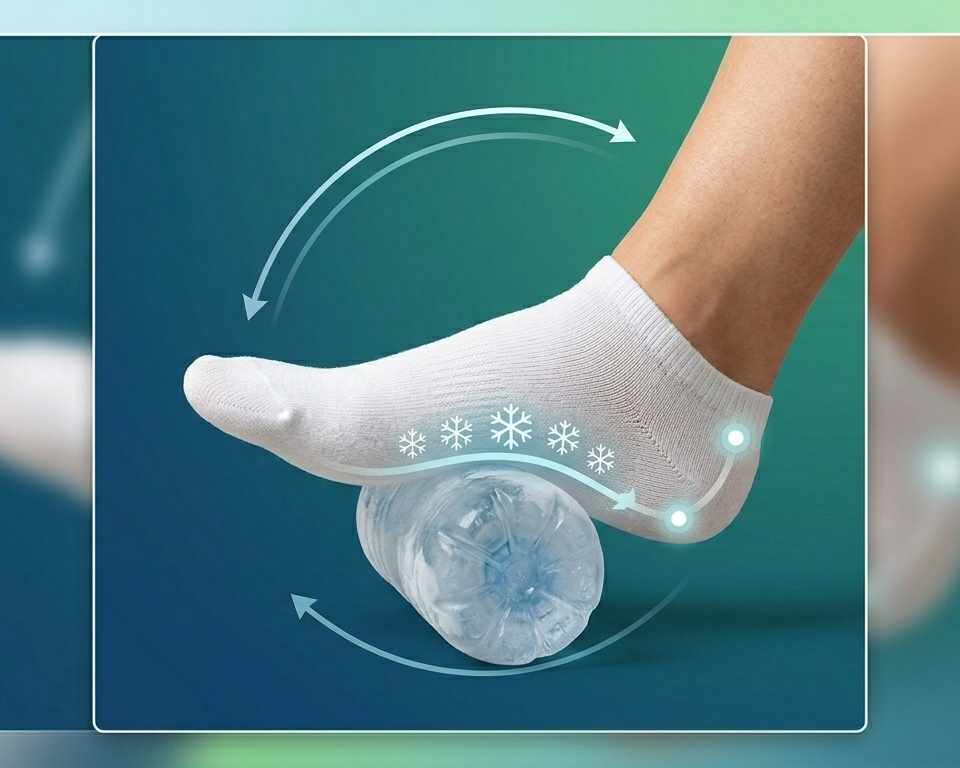
This is the best home care secret that I emphasize to my patients until they are tired of hearing it. This simple method is overwhelmingly better than expensive massage guns or sharp acupressure mats. Fill an empty 500ml round water bottle about 80 percent with water and freeze it in the freezer. A round shape fits the curve of the plantar arch perfectly compared to an angular bottle.
In the evening after work, sit with your back straight on a sofa or chair. If you stand and put your entire weight on it, the inflammation may actually worsen, so you must do it while sitting. Place the frozen water bottle wrapped in a thin towel under your sole and slowly roll it back and forth using the entire sole from just in front of the heel to the round area where the toes begin. The powerful cold compress effect of the ice calms the inflammation in the sole that has been heated up all day, and the round curved surface of the water bottle smoothly relaxes the stiff plantar fascia with your body weight. Press gently enough to feel a slightly aching yet refreshing pressure, and repeat for 10 to 15 minutes per foot every evening.
2. Must Wear Cushioned Slippers Indoors as Well
Changing your daily walking environment is just as important as the massage. In particular, Koreans have a developed floor-sitting culture where they take off their shoes and walk barefoot inside the house, which is like fatal poison to plantar fasciitis patients. This is because the impact of the hard living room or room floor is transmitted vividly to the inflamed fascia through the thinned heel pad.
Even if it feels hot and stuffy indoors, you must always wear soft indoor shoes with a sole cushion of at least 2 centimeters or thick slippers designed to prevent noise between floors. Even the barefoot impact of that short moment walking to go to the bathroom or drink water becomes poison when accumulated. When going out, unconditionally avoid flat shoes like Converse with thin soles or high heels, and wearing running or walking shoes that firmly support the arch of the foot with jelly-like soft cushioning in the heel is the first step to recovery.
3. Frequent Calf Stretching to Revive Ankle Mobility
Just because the sole of your foot hurts, treating only the sole will never cure it. One of the biggest causes that exacerbates sole pain is the shortening of the calf muscles. If the Achilles tendon and calf muscles leading to the heel are hardened like stones, the ankle does not bend back smoothly upward when walking. If the ankle doesn't move, all that burden and shock during gait is concentrated entirely on the plantar fascia of the sole.
Therefore, you must stretch your calves whenever you have free time. Stand with only the front half of your foot on the edge of a safe stair or a thick book, and slowly and gently lower your heel into the empty space below the stair. Feel a refreshing stretch as if the back of your calf is tearing, hold for 15 seconds, and come back up. Repeat this 3 sets of 10 times. A lunge-style stretch where you support yourself against a wall and extend the hurting foot far back to stretch the calf is also very effective. When the calves become flexible, the stress going to the soles is cut in half.
4. Muscle Strengthening Exercise by Picking Up a Towel with Toes
Going beyond passive massage, you must build the strength of the sole itself so that the muscles can share the weight the fascia has to bear. In our soles, besides the plantar fascia, there are many small intrinsic muscles that finely hold the bones together. This is the easiest and most definite way to strengthen these muscles.
Lay a thin towel long on the floor and sit on a chair. Barefoot, spread your five toes wide, then grab the towel as if pinching it and pull it toward your foot little by little. Squeeze your toes tightly and repeat until you have pulled the entire towel. This simple movement strongly contracts the intrinsic muscles of the sole, firmly lifting the weakened arch again and dispersing the tension applied to the plantar fascia. Try practicing consistently with a goal of pulling the distance of 5 towels a day while watching television.
The Positive Effects of Expert Nerve Gliding and Myofascial Release
When performing manual therapy on countless patients in the field, there are many cases where the pain is amplified not only by the issue of the plantar fascia itself, but also because the posterior tibial nerve passing through the inside of the ankle is compressed by surrounding tissues. Also, there are patients who hit a limit with just their own stretching because the fascia connecting the calf and the sole is stickily adhered.
Through professional manual therapy, if you correct the hardened micro-joints around the sole to revive the arch of the foot and apply a nerve gliding technique that opens up space for the nerve to slide smoothly, I witness every day that pain that has plagued them for months dramatically decreases. Continue to do the water bottle massage at home, but if the pain does not improve for more than 3 months and your walking posture begins to distort, do not delay and get an accurate expert evaluation and manual therapy help to prevent secondary knee or back pain.
Plantar fasciitis is absolutely not a light illness that magically washes away in just a few days. Because of the human destiny to walk bearing body weight every day, it takes considerable time for the inflammation to subside. You need to let go of impatience and have a relaxed mindset that complete recovery could take anywhere from 6 months to a year. The small practical change of freezing an empty water bottle in the refrigerator and ordering cushioned indoor slippers right tonight will make your first step every morning as light as a feather.
InfoTherapy will always support you so you can enjoy a pain-free, light first step every single day.
References and cross-verified data
American Podiatric Medical Association: Causes of plantar fasciitis and clinical effect guidelines of ice massage Link https://www.apma.org/plantarfasciitis
Mayo Clinic: Cold compress and stretching conservative treatments for sole pain relief Link https://www.mayoclinic.org/diseases-conditions/plantar-fasciitis/diagnosis-treatment/drc-20354851
Journal of Orthopaedic & Sports Physical Therapy: Verification of the effect of self-myofascial release in patients with plantar fasciitis Link https://www.jospt.org/doi/10.2519/jospt.2014.5336
View more posts