 Hello. This is InfoTherapy, prescribing healthy information.
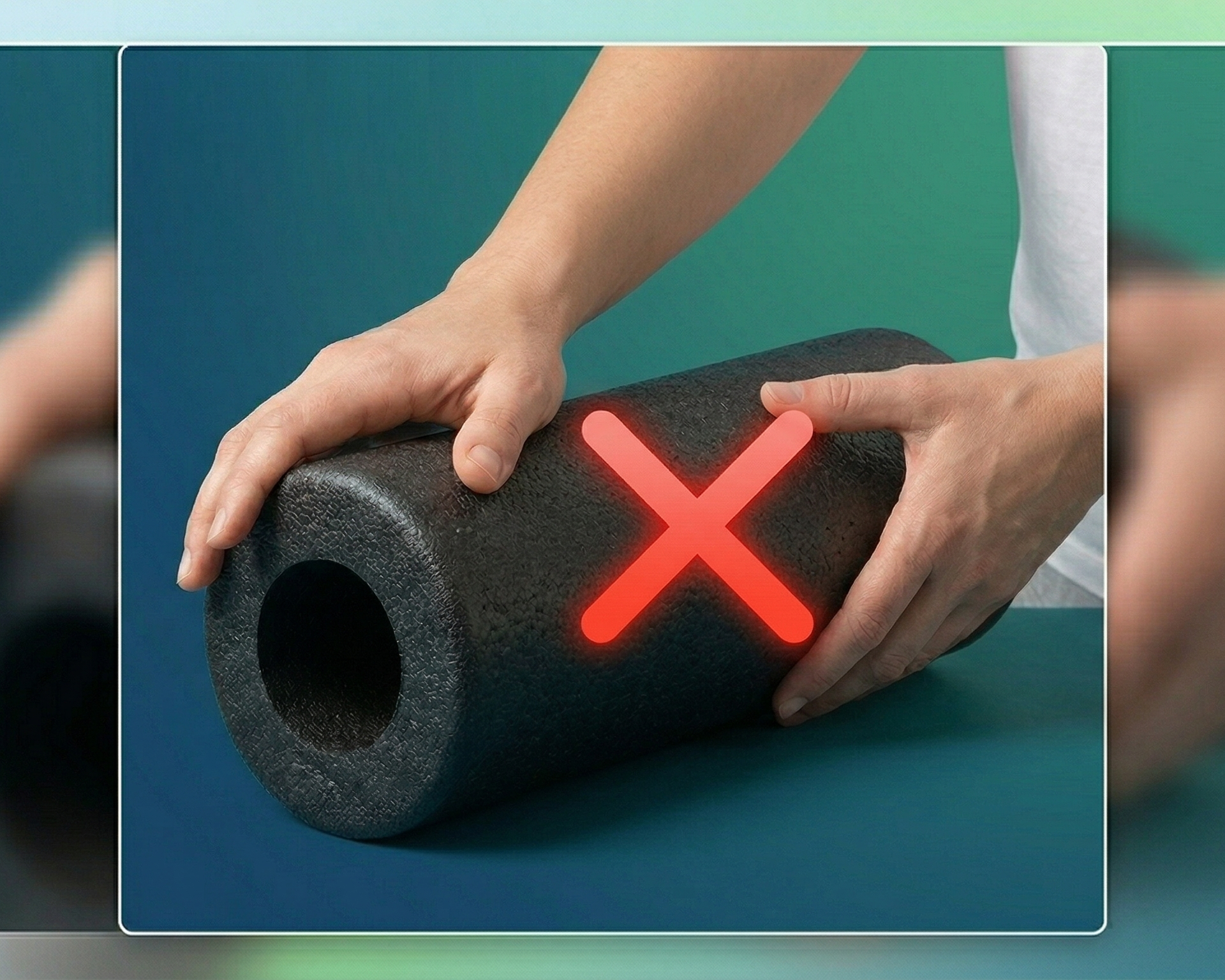
I am a physical therapist with 10 years of experience correcting patients' spinal joints and postures in the field. When consulting with patients about their lifestyle habits in the clinic, there is one essential item that occupies a corner of the living room in every household. It is the foam roller.
Many people simply think it refreshingly relaxes stiff muscles, so they find the painful spot, apply their body weight, and rub aggressively without hesitation. However, in reality, a surprisingly large number of people come limping into the clinic with acute pain due to torn fascia or pinched nerves from using a foam roller incorrectly.
Usually, when it comes to foam rollers, it is easy to imagine that the harder you press the stiff area, the better, and that muscles will only relax if you endure the pain. However, there are fatal absolute no-go zones in our bodies where, if you apply body weight and compress them, instead of feeling refreshed, your blood vessels could burst and nerves could become paralyzed.
Today, I will deeply explain the adverse effects of foam rollers that can give you lifelong nerve pain while trying to relieve muscle pain, the 3 prohibited zones where you must absolutely never apply body weight compression anatomically, and the true expert foam roller utilization methods that can relax your fascia 200 percent without side effects, significantly increasing the volume.
The Physiological Reason Why Foam Rollers Can Become Poison
From the outside, the muscles in our body look like a single lump of meat, but if you look inside, there is a tissue called the fascia that wraps around the muscle fibers layer by layer like thin, transparent plastic wrap. This fascia is a spiderweb-like structural network that connects the entire body as one, playing a very core role in helping muscles slide smoothly against each other and transmit force when we move our bodies.
The fundamental purpose of using a foam roller is not simply to crush the flesh, but to perform self-myofascial release, which smoothly relaxes this tangled and sticky fascia to restore its original elasticity. When the proper pressure of a foam roller is applied, the proprioceptors inside the muscle are stimulated and send a signal to the brain, and the brain issues a command saying that the muscle is excessively tense, so it should now release the tension and relax.
However, this physiological system only operates normally when proper pressure is applied. With the false belief that the more it hurts the better, if you forcefully rub while applying body weight to the point of tears, our body recognizes this not as a refreshing massage, but as a threatening external attack.
Eventually, to protect itself, the muscle bunches up even harder, fine capillaries burst causing dark blue bruises, and in severe cases, a rupture occurs where the fascia is torn. The reason your body aches and hurts as if you were beaten up when you wake up the next day is not that the muscles are relaxed, but because the fascia was damaged and an acute inflammatory response occurred. You ended up worsening the disease while trying to get a refreshing feeling.
3 Absolute No-Go Zones Warned by a 10-Year Physical Therapist
A foam roller is a tool used on broad muscle areas such as the thighs or calves. You must absolutely avoid areas where bones, joints, and nerves and blood vessels pass shallowly under the skin. I will point out the 3 absolute no-go zones that cause patients in the field to make the most mistakes and suffer the most serious injuries leading them to the hospital, along with anatomical reasons.
1. The lumbar region where you must never roll with body weight applied.
This is the most common and fatal mistake. Because their lower back feels stiff, many people place the foam roller horizontally across the center of their back, lie down, and roll forcefully up and down. However, the ribs in our body only wrap from the chest to the upper back, and there are absolutely no ribs to protect the bones in the lumbar region, which is the lower back.
If you place a hard foam roller on this lumbar region without a protective shield and apply your body weight, the lumbar spine will bend backward abnormally past its normal forward curve. If the thin muscles around the spine cannot withstand this pressure, that immense body weight load is transmitted entirely to the spinal discs and joints. This can tear a perfectly fine disc or cause the muscles around the lower back to suddenly stiffen, inducing an acute lumbar sprain. Also, the kidneys are located on both sides of the lower back, so strong compression can deal a blow to internal organs as well. If your lower back hurts, the medically correct method is to release the glutes or thigh muscles, not the lumbar spine itself.
2. The back of the neck where nerves and blood vessels pass shallowly.
Because the back of the neck is stiff due to a forward head posture or straight neck, resting your head on a foam roller like a pillow and rubbing it forcefully from side to side is a very dangerous behavior. The bones in the neck are much smaller and the joints are weaker than those in the lower back. Moreover, just beneath the skin on the back and sides of the neck, core blood vessels going up to the brain and thick nerve bundles going down to the arms pass like a spiderweb.
If you crush and create friction on this delicate area with a hard foam roller, nerves can be pinched causing numbness in the hands, or blood vessel walls can be minutely damaged before the stiff suboccipital muscles are even released. Especially for patients with a straight neck, if a hard cylindrical object compresses the cervical spine, the normal curve collapses, making the joints prone to inflammation. If you want to release your neck, instead of a hard foam roller, roll a towel and use it as a pillow, or use a massage ball just to gently press the muscle areas on both sides of the bone, not the bone itself.
3. The back of the knee area where lymph nodes and blood vessels are exposed.
To reduce leg swelling, some people release their calves and then move the foam roller up to the folding part behind the knee, apply their body weight, and rub. This behavior is a shortcut to ruining your leg health. The hollow behind the knee has very thin skin and is a deeply recessed space with absolutely no protective shield of fat layers or thick muscles.
Through this area, the popliteal artery and vein descending from the heart to the ends of the legs, and the thick tibial nerve connecting to the toes pass right under the skin. It is also a place where very important lymph nodes that filter out body waste are intensively gathered. If you forcefully crush this area with a foam roller, the arteries and veins are compressed, which completely blocks blood circulation in the leg, and as the nerves are pinched, a tingling paralysis symptom like an electric shock can occur across the entire sole. When releasing your calves, you must unconditionally leave the space behind the knee empty and only roll the bunched-up meaty part in the middle of the calf muscle.
Expert Tips for Using a Foam Roller 200 Percent Effectively Without Side Effects
Then how should you use a foam roller to relax the fascia most safely and reliably? The correct usage principles taught in the field by a 10-year physical therapist are much simpler than you think.
-
You must avoid bones and joints and only target large, thick muscles. The areas where a foam roller shines the most are the upper back protected by the ribs, gluteal muscles, the front and sides of the thighs, and the calves. Since these areas have a large muscle volume, even if you apply a certain amount of body weight, it does not strain the bones or organs, and you can properly see the effect of myofascial release.
-
Maintain only a pleasant pressure, stop, and press gently. If you rub painfully to the point of screaming, the muscles will tense up. If you find a painful spot, do not roll back and forth crazily. Instead, exhale deeply at that spot, stay still for 10 to 20 seconds, and just press gently with your body weight. This is the true ischemic compression technique that melts the fascia through pressure.
-
You should not exceed 1 to 2 minutes per area. You must discard the illusion that the longer you rub, the softer the muscles will become. If you continuously compress one spot for more than 2 minutes, blood flow actually decreases, and microscopic inflammation begins to accumulate in the fascia. The secret to maximizing recovery speed is to quickly move to different areas with the feeling of lightly sweeping the whole body and tapping the stiff spots.
A foam roller is not a cure-all or a torture device. It is just a very excellent rehabilitation tool that helps you independently control your body's tension. From today, before lying down on a foam roller to relax your stiff body after a diet or muscles exhausted from childcare, please be sure to remember the 3 absolute no-go zones revealed by a 10-year therapist.
Discarding the habit of rolling blindly and making the small change of stopping and pressing smartly will create a refreshing and light tomorrow without pain. InfoTherapy will always support you to enjoy the pleasure of moving healthily for a long time.
References and cross-verified data
National Academy of Sports Medicine: Physiological mechanisms and contraindications guidelines of self-myofascial release Link https://www.nasm.org/certified-personal-trainer/the-science-of-myofascial-release
American Academy of Orthopaedic Surgeons: Clinical risks of physical compression on the lumbar and cervical regions Link https://orthoinfo.aaos.org/
Mayo Clinic: Guide to proper foam roller usage and joint/nerve damage prevention Link https://www.mayoclinic.org/healthy-lifestyle/fitness/in-depth/foam-roller/art-20342371
View more posts