 Hello. This is InfoTherapy, prescribing healthy information.
I am a physical therapist with 10 years of experience helping patients with their rehabilitation in the field. When I evaluate the knees of patients who visit the clinic for knee pain and prescribe, "Don't just walk anymore; try lightly running for even 5 to 10 minutes a day," nine out of ten freak out and question me.
"Doctor, the hospital said my knee cartilage has weakened and I have chondromalacia. If I run, won't my cartilage wear out completely? Everyone around me told me absolutely not to run, and to only swim, walk, or ride an indoor bike." They look at my prescription with suspicious eyes.
However, this is a very fatal and unfortunate misunderstanding based on only half an understanding of the physiological structure by which our body's joints and cartilage regenerate. Especially if your cartilage has weakened and become mushy like water-soaked paper because you've rested from exercise for too long due to surgery or pain, you can never regain your original firm cartilage with simple walking, biking, or strength training alone.
Today, I will explain in great detail the shocking medical truth of why lightly 'running' (rather than aimlessly walking) becomes the only cure to regenerate cartilage when it has weakened, along with a practical 5-minute daily running rehabilitation guide passionately emphasized by a 10-year physical therapist.
Bloodless Knee Cartilage: The Secret of the 'Sponge Theory' Living on Nutrients
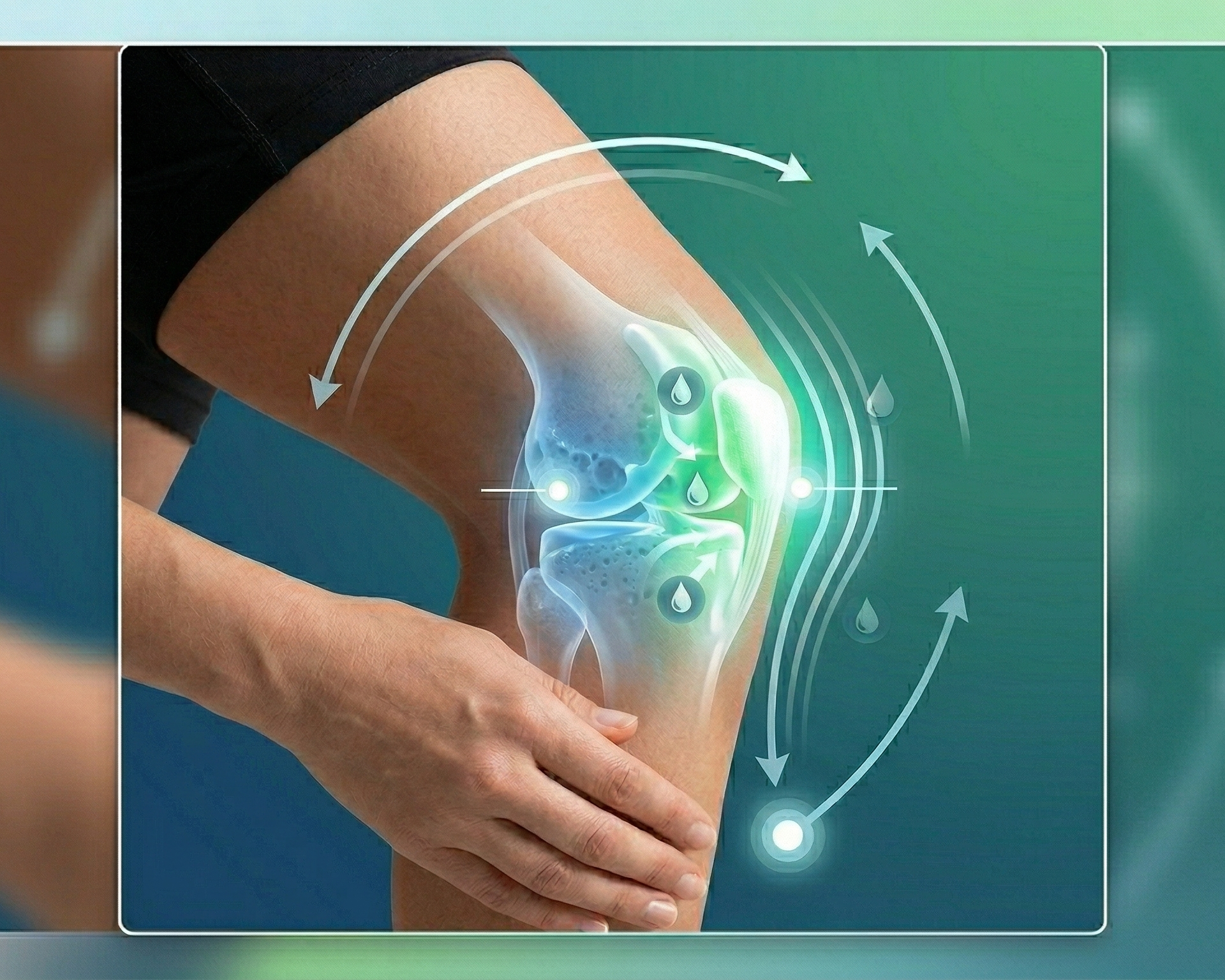
To understand this paradoxical truth, you must first know the unique anatomical structure of our knee cartilage. Our body's bones, skin, and internal organs have microscopic blood vessels stretching out like spiderwebs, receiving oxygen and nutrients pumped from the heart to heal wounds. Surprisingly, however, there is not a single blood vessel inside the 'cartilage' that acts as a cushion between bones.
Then how on earth does cartilage receive nutrients to maintain and recover itself? It is through the sticky synovial fluid (joint fluid) filling the knee joint capsule. Cartilage has exactly the same structure as a kitchen sponge with countless holes in it.
When we apply 'physical impact (compression)' to the knee by putting our body weight on it while walking or running, the sponge is tightly squeezed, expelling debris and waste products accumulated inside the cartilage out into the joint fluid. And when we lift our foot off the ground and the pressure disappears, the sponge swells back to its original shape, sucking in fresh joint fluid and nutrients from the surroundings deep into the cartilage.
In other words, knee cartilage is born with the physiological destiny of needing 'proper weight-bearing and impact' pressing down vertically just to breathe and eat.
Why Walking and Cycling Cannot Be the Answer to Recovering Softened Cartilage
The cartilage of patients who have been lying in bed for a long time or extremely reduced their activity level due to pain fails to receive nutritional supply, loses moisture, becomes crumbly, and falls into a state of 'chondromalacia' where the tissue thins and softens. To recover from this state, many people stubbornly stick only to indoor cycling, swimming, or flat-ground walking, which do not put a strain on the knees.
Of course, when the initial pain is too severe, these low-weight-bearing exercises are helpful. Strength training to build thigh muscles (quadriceps) is also essential for knee stability. However, this alone cannot make the 'softened cartilage itself' hard again.
Cycling or swimming lacks the compressive force to squeeze the sponge because body weight is not loaded. Walking is also a great exercise, but because one foot is always on the ground, it fails to provide a sufficient and powerful 'impact' to squeeze the cartilage sponge to the end and push new nutrients deep inside.
Just as strong friction on the skin is needed to form hard calluses, weakened cartilage cells (chondrocytes) need a powerful vertical compression stimulus that surpasses walking or cycling to feel a sense of crisis and produce (synthesize) a tougher, harder collagen net to protect themselves.
The Miraculous Physiology Where Running Actually Turns Mushy Cartilage into Steel
At this time, the most perfect cure becomes 'running (light jogging)'. Unlike walking, the running motion has a flight phase where both feet are in the air at the same time. The moment the foot lands on the ground, a load equivalent to 2 to 3 times your body weight drops onto the knee cartilage, creating powerful 'cyclic loading'.
Many people think this impact wears out the cartilage, but countless medical research results point to the exact opposite. Cartilage is weak against friction (rubbing force) but is designed to be incredibly strong against vertical compressive force. The rhythmic thumping impact generated while running powerfully squeezes the shrunken cartilage sponge to its deepest parts, perfectly expelling stagnant waste.
And the moment the foot lifts off, fresh joint fluid seeps deep into the cartilage like a waterfall, supplying explosive nutrients to the cartilage cells. The cartilage cells that received this powerful stimulus exponentially increase the secretion of 'glycosaminoglycans (GAG)' and collagen, the core ingredients that make cartilage hard, rebuilding the once-mushy cartilage to be elastic and tough like a tire.
In fact, looking at global sports medicine papers, it has been proven countless times that people who regularly enjoy light running have a much lower incidence of knee osteoarthritis and thicker cartilage compared to those who lead sedentary lives or only walk.
A 10-Year Therapist's Prescription: 5-Minute Safe Running Rehab Guide
However, there is something you must absolutely not misunderstand here. Just because running is good for weakened cartilage, it does not mean you should put on your sneakers, go outside right now, and run 3 miles out of breath on asphalt. If a suddenly long and strong impact is applied to cartilage that has become soft from resting for a long time, the cartilage won't be able to withstand it and could actually tear.
The key lies in 'progressive overload', where you very slowly increase the amount of impact while buying 'time' for the cartilage to absorb nutrients and harden itself.
-
Start very short, unconditionally between 5 to 10 minutes. For the first week, start by taking a light 30-minute walk outside, mixing in exactly 5 minutes of a running motion in the middle. You don't need to be out of breath, and even if it's similar to your walking pace, a 'bouncy light jog' where both feet slightly lift off the ground is sufficient. 5 minutes is more than enough for the pumping action that squeezes nutrients into the cartilage.
-
You must have one or two rest days after running. Just as muscles grow while resting after a workout, cartilage also needs rest time to synthesize collagen and harden after receiving an impact. Running every day is poison to weakened cartilage. Run for 5 minutes only once every two days or 3 times a week, and substitute the remaining days with light walking or indoor cycling while monitoring the cartilage's recovery response.
-
Stop if the pain exceeds a 3 on a numerical scale while running. The stiffness or slight discomfort (level 1 to 3 out of 10) felt in the knee when running lightly is a positive sign that stiff joints are loosening up and nutrients are entering, so you can rest assured. However, if you feel a sharp stabbing pain or pain above a 4, your cartilage is not yet ready to handle that impact, so you must stop immediately and return to walking.
-
Choose a urethane track or dirt path over cement floors. Hard asphalt or cement floors do not absorb shock at all, dealing unnecessary damage to softened cartilage. It is safest to start on a school playground's urethane track, a soft dirt path, or a treadmill with good cushioning. Wearing running shoes with heavily cushioned soles is the absolute basics.
"Cartilage is not an eraser that wears out the more you use it."
The bones and cartilage in our body are living tissues, and when given the proper stimulus and impact, they have an amazing regenerative ability to carve and refine themselves to become stronger in adaptation to that environment. If you've been overprotecting your knees, stubbornly only walking out of fear of pain, from today, please trust the prescription of a 10-year physical therapist and try lightly running for just 5 minutes in your neighborhood park.
It might be scary at first, but the light impact of those 5 minutes will breathe life into your mushy knee cartilage, rebirthing it into steel-like knees capable of effortlessly handling any exercise. InfoTherapy will always support you so that you can enjoy the pleasure of kicking off the ground vigorously with both legs for a long time.
References and cross-verified data
-
Journal of Orthopaedic & Sports Physical Therapy (JOSPT): Meta-analysis comparing the incidence of hip and knee arthritis in recreational runners and non-running populations (demonstrating significantly lower incidence of arthritis in runners)
-
Medicine & Science in Sports & Exercise: A Study on the Positive Effects of Cyclic Loading on the Biochemical Composition and Thickness Increase of Knee Articular Cartilage
-
Journal of Osteoarthritis and Cartilage: Analysis of the Correlation between the Principle of Mechanotransduction in Chondrocytes and Cartilage Matrix Synthesis
See other posts