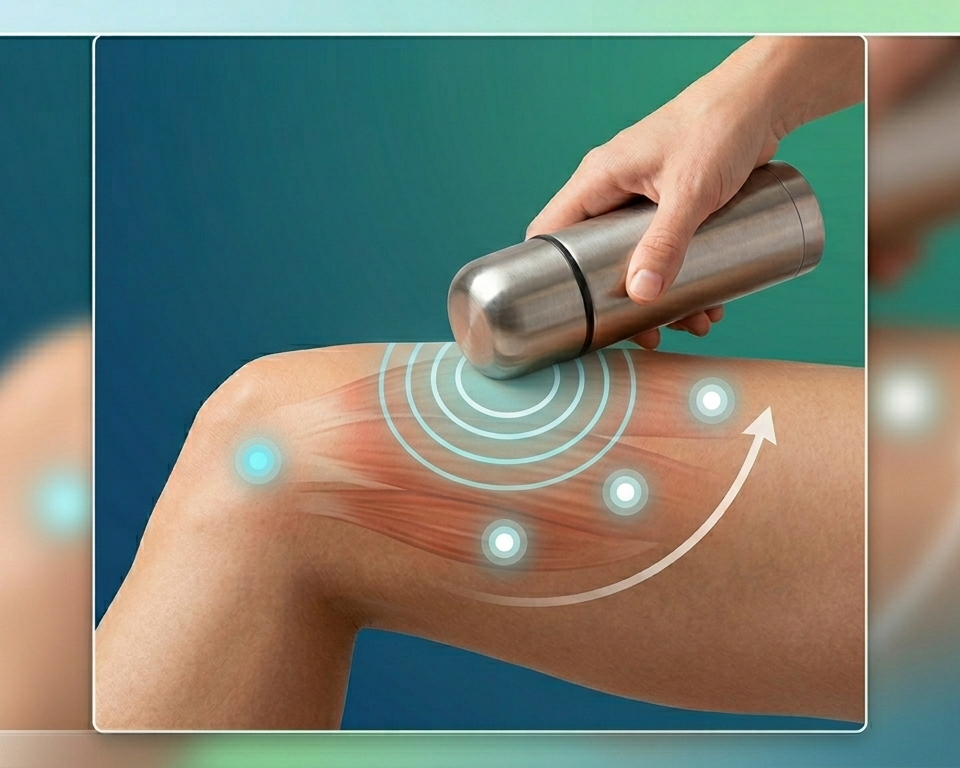
Yes, to start with the conclusion: it is possible. As a current manual therapist, I will explain the principles and methods of relieving knee pain using a thermos.
When parents say, "My knees ache whenever I go up or down the stairs," many people immediately reach for pain relief patches or supplements. However, from my experience treating patients, I’ve found that the pain is often caused less by the wear and tear of the knee joint itself and far more by the surrounding muscles—which are supposed to protect the knee—becoming stiff and hardened, thereby exacerbating the discomfort.
Today on InfoTherapy, we are introducing a special method that allows you to easily follow professional myofascial release techniques—used in clinical settings—right at home. The preparation is simple. All you need is a single sturdy thermos, something found in almost every household.
Why a thermos, of all things?
While there are many tools on the market, such as foam rollers and massage guns, a thermos can actually be the optimal tool for seniors. This is because the heavy weight created by filling the thermos with water, combined with its firm surface, allows pressure to be delivered deep into the muscle tissues. (If you try it yourself, you'll find that a thermos is far more effective than a massage gun.)
In particular, techniques that require shifting body weight—like using a foam roller—can be difficult for elderly parents to balance and may even place undue stress on their joints, increasing the risk of injury. In contrast, using a hand-held thermos to apply pressure allows for minute adjustments, making it a far safer and more precise method for targeted care.
Practical Thermos Therapy: The "Press-and-Glide" Technique
The core of this method does not lie in simply rolling the thermos; rather, it is rooted in a specific technique of maintaining a firm grip and applying deep, sustained pressure while gliding. This process is designed to mechanically release adhesions between the fascia and muscle tissues and to restore stagnant blood circulation. To prevent skin abrasions caused by friction, do not perform this on bare skin. It is imperative to perform the technique over trousers or by placing a towel over the treatment area.
-
Quadriceps Care (Front of the Thigh): Begin by having your parents sit or lie down in a comfortable, relaxed position. Grasp the thermos—now heavy with water—firmly with both hands. Starting from the upper thigh and moving toward the knee, apply deep, steady pressure and glide the tool downward. The critical point of this technique is to lock your wrists and maintain a fixed grip to prevent the thermos from rotating or rolling. By inhibiting rotation, you ensure the pressure is directed deep into the tissue rather than slipping over the surface. Repeat this slow, deliberate gliding motion approximately 10 times.
-
IT Band Care (Lateral Thigh): A hidden culprit behind knee pain is the Iliotibial (IT) Band, a thick, fibrous band of tissue running down the outside of the thigh. When this structure becomes excessively tight, it exerts a lateral pull on the patella (kneecap), leading to significant alignment issues and discomfort. Apply deep, gliding pressure along the lateral aspect of the thigh using the thermos. For those with chronic knee issues, this area is often hypersensitive; therefore, it is crucial to monitor your parents' verbal and non-verbal cues and calibrate the intensity of the pressure accordingly.
-
Tibialis Anterior Care (Shins): The tibialis anterior, the primary muscle responsible for lifting the ankle (dorsiflexion), plays a critical role in gait stability. If this muscle becomes chronically tight, it leads to an unstable stride and significantly increases the mechanical load on the knee joints. Using the thermos, apply deep, gliding pressure along the muscular belly located just lateral to the shinbone. Clinical Caution: It is imperative to focus the pressure solely on the soft tissue; do not apply direct force to the tibia (shinbone) itself. Doing so can cause unnecessary periosteal irritation and pain.
Sustainable Therapy: Achieving Consistent Self-Management
Unrestricted Access: Therapy Anytime, Anywhere The most significant advantage of this method is its complete independence from time and location. It allows parents to manage their own care or enables children to offer immediate support without the need for formal clinical appointments or heavy, cumbersome massage equipment. Integrating this into your daily life requires no grand preparation. Utilizing just 10 minutes while watching television or before retiring for the night is more than sufficient. Because a thermos is lightweight and maintenance-free, it can be kept on a bedside table or a living room stand—ready to be picked up the moment it is needed. Clinical Insight: We often see patients struggle with "compliance" because their home programs are too complex. By simplifying the tool to a common household item, we remove the psychological barriers to rehabilitation. Accessibility is the first step toward long-term recovery.
The Clinical Power of Consistency: Low-Intensity, High-Frequency Stimulus As a manual therapist, the single most important principle I wish to emphasize is this: A consistent, daily stimulus—even at a low intensity—is far more effective at reducing muscle tone than a single session of aggressive treatment. The thermos massage technique is inherently simple and carries minimal risk, allowing the elderly to become proficient in their own care almost immediately. When patients develop the habit of proactively caring for their own bodies, the vague, paralyzing fear of pain begins to dissipate. This psychological shift is the true first step toward Active Aging—empowering seniors to maintain their functional independence and enhance their overall quality of life.
The Science Behind the Relief: Why Does Pain Diminish?
The Clinical Foundation: Thermos-Assisted Passive Compression in Rehabilitation Medicine
First: The Mechanism of Ischemic Compression The application of targeted pressure using a thermos effectively utilizes the principle of Ischemic Compression. By applying firm, sustained pressure to a myofascial trigger point, we intentionally create a temporary, localized restriction of blood flow (ischemia). The clinical magic happens upon release: the sudden removal of pressure triggers reactive hyperemia—a rapid, powerful influx of fresh, oxygenated blood to the treated area. This physiological surge serves two critical functions: Metabolic Flushing: It "washes away" accumulated metabolic waste and inflammatory byproducts (such as lactic acid and substance P) that have been trapped within the hypertonic muscle fibers. Nutrient Resupply: It restores the supply of oxygen and essential nutrients, breaking the metabolic "crisis" that keeps the muscle in a state of chronic contraction.
Second: Lymphatic Circulation and Edema Reduction Swelling around the knee joint significantly restricts the Range of Motion (ROM) and exacerbates pain. The "Press-and-Glide" motion of the thermos provides mechanical assistance to the lymphatic flow, which is highly effective in reducing localized edema (swelling). By facilitating the drainage of stagnant fluid, this technique alleviates intra-articular pressure and restores functional mobility.
Conclusion: A 10-Minute Therapy for Your Parents
Final Thoughts: A 10-Minute Therapy for Your Parents The thermos massage technique introduced today is one of the most effective ways to show care for your parents’ well-being—requiring no specialized skills, only a sincere commitment to their health. By dedicating just 10 minutes a day to applying this "Press-and-Glide" technique to their fatigued legs, you are facilitating a profound physiological shift. As stagnant circulation is restored and muscle elasticity improves, your parents will experience a noticeably lighter and more confident stride.
I can assure you that the physiological results of this technique are often more immediate and definitive than those of any oral supplement. Why not take a thermos from your kitchen right now and approach your parents to begin this practice?
Academic References and Citations
The efficacy of the massage therapy proposed in this post has been substantiated through large-scale clinical studies. These research findings provide objective evidence that systematic, manual compression protocols significantly contribute to pain reduction and functional improvement in geriatric populations.
-
Efficacy of Massage in Knee Pain Improvement: According to a large-scale clinical study by Perlman et al., published in JAMA Network Open in 2019 (Effect of Total Weekly Massage Therapy Dose on Moderate to Severe Knee Osteoarthritis), research conducted on 222 patients with knee osteoarthritis confirmed that regular massage therapy has significant and long-term effects on pain relief and physical functional improvement. (Source: Perlman, A. I., et al., 2019). https://pubmed.ncbi.nlm.nih.gov/30543021/)
-
Mechanism of Self-Myofascial Release (SMR): Research by Cheatham et al. (2015), published in the Journal of Athletic Training, suggests that tool-assisted myofascial release is a safe intervention that increases the Range of Motion (ROM) without compromising overall muscle performance. (Source: Cheatham, S. W., et al., 2015). https://www.ncbi.nlm.nih.gov/pmc/articles/PMC4637917/)
-
Cellular-Level Recovery Mechanisms: Research by Crane et al. (2012), published in Science Translational Medicine, has revealed that massage therapy inhibits inflammatory signaling in muscle cells and promotes mitochondrial biogenesis, thereby facilitating accelerated tissue repair and recovery. (Source: Crane, J. D., et al., 2012). https://www.science.org/doi/10.1126/scitranslmed.3002882)
View more posts