
Observing the gait of a female patient in her 40s who opened the treatment room door and entered this morning, I instinctively sensed the cause of her pain even before starting treatment. Her pelvis swayed sharply to the left as she shuffled along, and the thin, stiff flat shoes she had taken off when lying down on the bed. Sure enough, she complained of pain, stating that her lower back pain had not subsided for months and that her calves felt like they were about to burst.
When many people experience back, neck, or knee pain, they tend to think only of problems with the bones or muscles themselves, or issues with their sitting posture. They say, “It’s because I use the computer too much,” or “It’s because I stand with one leg shorter than the other.” Of course, that is true. However, there is one undeniable truth that I have realized over 10 years of clinical practice, directly examining and correcting the bodies of tens of thousands of patients.
Imagine our body as a massive structure. If the spine is the pillar, the very foundation supporting it is the 'foot.' And what wraps around and protects that foundation is the 'shoe.' If the foundation is shaky or tilted, can the pillar (spine) built upon it remain straight? It is absolutely impossible. If the shoes collapse, the entire spine will eventually fall like a domino.
Today, as a manual therapist with 10 years of experience, I will realistically outline, based on my clinical experience, the three worst types of shoes I would never wear—no matter how much money I was paid or how pretty the design—along with the criteria for truly good shoes that save your spine and knee joints. I am confident that if you read this article to the end, you will be able to save hundreds of thousands of won in hospital bills immediately.
1. Why Wearing the Wrong Shoes Can Cause Back and Neck Pain (The Secret of the Kinetic Chain)
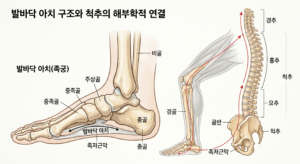
“There are so many patients who ask, ”It’s not my feet that hurt, it’s my back that hurts, so why are you talking about shoes?‘ Our bodies are connected like a single organic chain from head to toe. In medical terms, this is called the 'Kinetic Chain.'.
Our soles have a natural arch structure that absorbs the impact of body weight generated when walking or running. It acts like an arched bridge supporting the legs or a car's suspension (shock absorber). A normal arch and good shoes disperse the impact of body weight, amounting to 1201 TP3T, applied to the soles of the feet when walking.
However, what happens if you wear ill-fitting shoes with poor soles or a distorted structure? The shock that the soles of your feet fail to absorb travels up the ankles, strikes the knee joints, passes through the hip joints, and is transmitted directly to the spine and neck bones. It is like subtly tapping your spine with a hammer every time you walk. This means that the reason your lower back ached and the back of your neck felt tight today might not have been because of your smartphone, but because of the uncomfortable shoes you wore all day yesterday.
2. 3 Shoes a 10-Year Veterinarian Would Never Wear Even If Paid
There are certain shoes in the treatment room that allow you to estimate a patient's condition just by looking at them. We are revealing the three worst shoes that you wear unwittingly in your daily life, yet are like poison to your joints.
① Pretty Trash: Heel-less 'Flat Shoes' and Backless 'Bloafers'‘
While female patients are well aware that high heels are bad for the back, there are far too many who mistakenly believe that flat shoes are safe because they have low, flat heels. However, in my eyes as a therapist, flat shoes or slip-ons with thin, hard soles and heels less than 1cm are the number one shoes to avoid.
Because there is absolutely no cushioning, the impact generated when walking on asphalt is transmitted directly to the heel bone and knee. Over 80% of patients with plantar fasciitis prefer to wear these hard, thin shoes. Furthermore, when wearing backless shoes like loafers or mules, people unconsciously curl their toes tightly to prevent the shoes from slipping off while walking. Applying excessive force to the toes in this way causes the calf muscles to remain tense all day, eventually leading to chronic edema characterized by nightly cramps and severe leg swelling.
② The illusion that it is comfortable because it is soft, 'Cushioned sponge platform shoes'‘
“There are shoes that people proudly show off, saying, ”Doctor, these shoes are so soft and cushioned that they don’t hurt even if I walk all day!” These are usually thick-heeled sneakers made of memory foam or soft sponge materials. However, these are also fatal to spinal health.
When we walk and our soles strike the ground, there must be an appropriate amount of firmness and resistance for our brain to recognize, "Ah, the ground is here," and maintain our balance. This is called proprioception. However, if you wear shoes that are too soft and cushioned, like sand, your brain becomes confused with every step, and your ankles wobble slightly back and forth. Consequently, the tiny ligaments around the ankles, knee cartilage, and pelvic muscles are forced to work overtime all night to forcibly stabilize the wobbling ankles. While they may feel as comfortable as walking on clouds when you first put them on, the reason you feel as if your whole body has been beaten up upon returning home is precisely because of this disrupted balance.
③ National favorites for neighborhood strolls: Stiff 'three-stripe slippers' and oversized 'Crocs'‘
These are the national staples that people drag around every day, whether for office indoors or just for a quick stroll outside. Slippers or loose-fitting Crocs fail to firmly support the instep and heel, causing the foot to sag. Normal walking requires a smooth roll in the sequence of 'heel ➡️ outer edge of the sole ➡️ forefoot (big toe).' However, wearing slippers creates an abnormal walking pattern where you drag your feet on the ground to prevent them from slipping off, or walk with your ankles lifted upward. This leads to excessive use of the muscles in the front of the thighs, causing the pelvis to tilt forward (anterior pelvic tilt) and acting as a trigger for severe herniated discs.

3. Check in just 1 minute at home! Self-diagnosis method for your shoe lifespan
So, how can you tell if the shoes you wear every day are ruining your body? There is a very simple self-diagnosis method. Go to the entryway right now and check the soles of the shoes you wear most often.
-
Normal wear: If the outer side of the heel is slightly worn and the front side is evenly worn, you are walking normally.
-
Dangerous wear and tear (Discard immediately):
-
Only the inner side of the heel is severely gouged or worn down. (Progressing flat foot, risk of X-shaped legs)
-
Only one side of the shoe (left or right) is worn down significantly, making it asymmetrical. (Suspected pelvic misalignment, scoliosis)
-
Only the toe area is worn down particularly severely. (Risk of calf muscle shortening and Achilles tendonitis)
-
Continuing to wear shoes with a sole that has collapsed on one side is like driving a car with one flat tire at 100 km/h. You should not feel bad about it and boldly throw them in the trash to save on medical expenses.
4. The 3 Major Formulas for Choosing 'Really Good Shoes' Recommended to Patients in the Treatment Room
So, what kind of shoes should you buy to protect your body and even get corrective effects? Do you have to buy expensive custom-made functional shoes costing hundreds of thousands of won? No. When choosing sneakers at a regular store, you just need to remember the following three formulas.
① Firmness of the heel counter: Press with your finger.
The part that wraps around the heel of a shoe is called the heel counter. When you visit a shoe store, try pressing firmly on the back of the shoe with your thumb. You should never buy shoes that sag limply. The shoe must hold its frame firmly enough to make your finger hurt; only then will it tightly support your ankle like a cast, preventing it from collapsing inward or outward while walking.
② Heel thickness and elasticity: A 2–3cm 'stickiness' is key.
The ideal heel height is around 2.5 cm, neither too thin nor too thick. Additionally, the sole should be made of an elastic material that feels "sticky" and offers some resistance when pressed with a finger, rather than sinking in like a sponge. Try holding the shoe with both hands and twisting it like you are wringing out a rag. A shoe optimized for walking mechanics is one where the center (arch area) stands firm, while only the one-third of the toe area bends smoothly.
③ Toe box clearance: You must be able to play the piano with your toes.
With your shoes on and laces tied tightly, try wiggling your toes as if playing a piano. There must be sufficient space (toe box) for your toes to move freely. When walking, the 'push-off' motion—where your big toe forcefully pushes off the ground—must occur to properly engage your gluteal muscles and protect your lower back. Shoes that are too tight around the ball of the foot or have pointed toes completely block this crucial process.
Therapist's extra tip: Always shop for shoes after 4 PM!
Due to the influence of gravity, our feet swell and slightly enlarge later in the afternoon compared to the morning. If you buy shoes that fit perfectly in the morning, your feet will feel tight when you leave work in the evening, hindering blood circulation. When shopping for shoes, be sure to visit around 4 to 5 PM when your feet are most swollen. The perfect way to choose the right size is to select shoes with about 1 cm of space between the tip of your longest toe and the toe while wearing thick socks.
In conclusion
Try opening the shoe cabinet at home. The real culprits that have been causing your back and knee pain might be hiding everywhere—those that do not meet the standards I mentioned today.
While receiving expensive manual therapy and taking medication are important, pain will inevitably recur unless you change the fundamental environment of your daily life. Starting today, why not put down those hard, thin, and pretty "trash" and switch to sturdy sneakers that provide soft yet firm support for your ankles? Once your foundation is stable, your body will be the first to feel comfortable. We wish you a pain-free life!
Helpful home care tips to read along with this article (Internal link recommended)
I am serializing on my blog the cost-effective home care tips for correcting body alignment that I share with countless patients in my clinic. If you have recently changed your shoes, I strongly recommend that you also check out the articles below to help loosen up your stiff body.
References and Medical Citation Sources (External Links)
This post is written to provide general health information and has been reviewed based on gait mechanisms from the authoritative medical institutions and research data listed below. For an accurate diagnosis of individual conditions, we recommend consulting a nearby orthopedic specialist.
[Author Profile: Woo-gu, Manual Therapist with 10 Years of Experience] I hold a physical therapist license certified by the Ministry of Health and Welfare and have been treating the spines and joints of numerous patients for the past 10 years at a local pain clinic and rehabilitation medicine department. I share the most realistic and practical health and home care information, proven by daily encounters in the clinical field, rather than complex medical information confined to theory.